
Pressed between the Xingu and Tocantins Rivers in the eastern Amazon, the Asurini do Tocantins have survived one of the more turbulent contact histories of any indigenous people in Brazil. They call themselves simply Asuriní, a name that came to them not from their own language but from the Juruna people — used since the 19th century to designate various Tupi-speaking groups in the region. An earlier name, Akuáwa, once served as their self-designation, but over time it acquired a pejorative meaning — "wild Indians," "forest Indians" — and the community set it aside in favor of Asuriní.
Their language belongs to the Tupi-Guarani family, in the same linguistic subgroup as the Parakanã and Suruí do Pará. Indeed, the Asurini and Parakanã trace a common origin — they once formed a single people in the Xingu region. Early in the 20th century, driven by internal fissions and conflicts with other indigenous groups, a contingent migrated eastward into the headwaters of the Pacajá River and eventually into the forests between the Pacajá and the Tocantins, the territory they have occupied since. Today they live in the Trocará Indigenous Territory, roughly 24 kilometers north of the town of Tucuruí in the state of Pará, on a demarcated reserve of about 21,700 hectares bordered on all sides by cattle ranches. A highway, the PA-156, bisects the territory, dividing the village and FUNAI post from a rectangle of primary forest to the west — one of the last significant stands of intact rainforest left in the municipality.
The Asurini's modern history is marked by near-annihilation. When 190 individuals made first official contact with the Brazilian Indian Protection Service in 1953, more than fifty died within the year from influenza and dysentery. The survivors fled repeatedly into the forest, returning only in stages through the 1960s and 1970s. At their lowest point, the entire population at the Trocará post numbered barely two dozen souls. Population recovery began after 1974, when a separate Asurini group from the Pacajá River reunited with the Trocará community, and steady demographic growth has continued since.
The Asurini are manioc farmers and fisher people. Bitter manioc is the dietary and cultural cornerstone — grown in both communal and household fields, processed into manioc flour, and sold in Tucuruí for cash to purchase coffee, sugar, kerosene, and other goods. Before contact, hunting was equally important: deer, peccary, tapir, monkey, and armadillo were taken with the bow and arrow. Deforestation surrounding the territory has gutted game populations, and today fishing carries the greater subsistence weight. During July and August, when water levels in the nearby lakes drop too low for easy fishing, entire families relocate for several days to more distant rivers and streams — occasions the Asurini describe with particular pleasure, as it is on these camping trips that they eat well and regain their strength.
Women produce crafts for sale — animal-tooth necklaces, basketry, featherwork, and pottery — and these items are sold through intermediaries in Tucuruí. Traditional Asurini society was organized around small, patrilineal local groups, each living in a single communal house, with the shaman often serving simultaneously as headman. Contact and demographic collapse disrupted those structures significantly, and the current community is a merged group drawing from what were once distinct local groups.
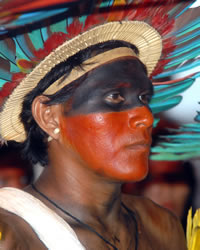
Ceremonial life still pulses through the community. Two categories of ceremony structure the ritual year: one marks the planting season, featuring communal dancing, flute playing, and shared manioc porridge; the other accompanies the initiation of a new shaman. Music is made with panpipes, short bamboo flutes, and the great ceremonial flutes — instruments that can reach two to three meters in length — each melody bearing a name drawn from the natural world, such as "fire music," "tapir," or "parrot." For ceremonies, men and women paint their bodies and don feather ornaments, sometimes covering themselves with feathers affixed with resin.
Children are named for the dead — always — and in this way the community keeps the memory of its ancestors alive from birth. Both parents observe the couvade after a birth, avoiding heavy labor and certain foods until the umbilical cord falls away.
Christianity has taken substantial root among the Asurini do Tocantins, and the community is now almost entirely identified as Christian, with a significant evangelical presence. Linguistic work and Scripture translation by members of the Summer Institute of Linguistics beginning in the 1960s opened the community to the biblical text in their own language, and that engagement produced lasting fruit.
Alongside Christian identity, the traditional Asurini spiritual world remains very much alive. Their cosmology divides the supernatural into two independent domains. The first belongs to Mahira — the creator of human beings, who organized the physical universe, hardened the earth with the tapir's help, separated sky from earth, and first taught humans to cultivate manioc and make music. Mahira now dwells in the sky at a place called Tapana, where the dead also go. It was after Mahira's departure from the earth that sickness first appeared among humans.
The second domain belongs to Sawara, the Jaguar-spirit, who governs shamanism. To become a shaman, a man must walk a dream-path through danger until he reaches Sawara and receives from him the karowara — supernatural healing power. The shaman's role is to extract from the sick the objects placed inside them by spirit-beings of the forest, which cause illness by raising body temperature. He accomplishes this by blowing tobacco smoke over the patient and drawing the objects out through suction. A shaman who is buried according to the proper ritual procedures, carried out by women, is believed capable of resurrection — a form of rebirth understood to be the ideal destiny for men. This belief in shamanic resurrection exists alongside, not displaced by, any understanding of resurrection in Christ.
Not merely a specialist's concern, shamanic knowledge is considered foundational to male identity. All Asurini men are regarded as at least partial shamans; contact with the spirit world is simply part of what it means to be a man. For much of the community, faith in Jesus Christ and engagement with the spirit world through shamanic practice coexist without sharp contradiction.
The Asurini do Tocantins live under persistent environmental and economic pressure. Surrounded by cattle ranches, their territory is an island of forest in a deforested landscape. Illegal hunters from outside regularly invade their land, depleting the game that has always supplemented their diet. The Tucuruí hydroelectric dam, built upstream between 1975 and 1984, transformed the Tocantins River ecosystem, eliminating the rapids where migratory fish once ran — fish for which no passage was ever built at the dam. The resulting changes to the river's fish populations hit the Asurini directly, as they were never compensated for these losses.
Malaria has been a chronic and serious health concern since the dam construction era brought massive population influx and accompanying mosquito habitat changes. Access to reliable healthcare remains limited, given the community's small size and relative isolation. Clean water and sanitation infrastructure also need sustained attention. Educational access beyond the village school is difficult, and the Asurini language itself — already shifting toward Portuguese, especially among younger generations — requires intentional documentation and revitalization effort if it is to survive.
Give thanks to God that a significant evangelical presence has developed among the Asurini do Tocantins, and pray that Asurini believers would be grounded deeply in Scripture, finding in Christ the power over sickness, death, and the spirit world that shamanic practice promises but cannot ultimately deliver. Pray that Asurini disciples would be raised up and sent out to carry the gospel to other unreached indigenous peoples of the Tocantins and Xingu river basins who have never heard the name of Jesus. Pray for the protection of the Trocará Indigenous Territory from continued land encroachment, illegal hunting, and the environmental degradation that threatens the Asurini's physical survival and way of life. Pray for consistent healthcare access — particularly for malaria prevention and treatment — and for the language revitalization efforts that would allow future generations to encounter God's Word in the tongue their ancestors have spoken for centuries.
Scripture Prayers for the Asurini do Tocantins in Brazil.
https://joshuaproject.net/people_groups/10470/BR
https://pib.socioambiental.org/en/Povo:Asurini_do_Tocantins
https://www.encyclopedia.com/humanities/encyclopedias-almanacs-transcripts-and-maps/asurini
https://www.everyculture.com/South-America/Asurini.html
https://en.wikipedia.org/wiki/Bakairi_people
Laraia, Roque de Barros, and Roberto da Matta. Índios e Castanheiros: A Empresa Extrativa e os Índios no Médio Tocantins. 2nd ed. Paz e Terra, 1978.
| Profile Source: Joshua Project |